What is metagaming? Consider a boardgame like Chess. The basic rules of the game are pretty simple. Each piece on the board has its own set of movements, and the objective is to checkmate the opponent's king. However, chess is much more complicated than its basics. There are many different strategies to winning the game, and just as many strategies meant to counter those strategies, and then there's ways to adjust and balance out or beat that strategy. To put it simply, the metagame is the game outside of the game which affects how an individual plays.
A metagame can present itself in different forms and ways depending on the type of game you're playing, and is actually very broad in what it can exactly entail. I'll give three examples featuring TCGs, Tabletop RPGs, and MOBAs.
In a trading card game, the competitive metagame involves understanding which deck archetypes are popular in each competitive format. For example, in the week following the release of the Theros set, the most competitive decks involved UW (and/or Esper) Control, Mono-Red Aggro, and GR Midrange. In tournament play, these would be the most common decks. Esper Control is defined by its use of five cards, so if someone is playing Blue, White, and possibly black you can expect them to have 3-4 of each of the following in their deck: Azorius Charm (card draw and creature removal), Detention Sphere (card removal), Supreme Verdict (field wipe), Sphinx's Revelation (life gain and card draw), and Jace, Architect of Thought (card advantage). As a finisher, it will more than likely have two Aetherlings (a very evasive and hard to remove creature), and as a control deck, it will have a variety of kill and counter spells. Knowing this, the player can adjust their strategy and sideboard (a side deck of 15 cards they can switch cards in and out from their main deck between matches) before their next match, giving themselves an advantage because they knew what they were possibly against and had strategies prepared to go against it.
In a tabletop RPG, the players are set against the dungeon master and whatever their campaign can throw against them. A player can choose to play as their character in-game would deal with the situation, but this can be disastrous if for example the character has no idea the statistical chances of surviving any instance would be or that staring at the snake-headed lady is likely to get you turned into a rock. In contrast a player with the proper knowledge can make decisions like not getting in a staring contest with Medusa. By taking information outside of whatever is going inside of the game, the player can survive and possibly outwit the dungeon master and accomplish any challenges that are presented.
As for MOBAs, like League of Legends, the metagame is defined by strategies that are used in the competitive scene. The game has no defined rules as to who goes where, but the common strategy, and basic metagame, that is supported by the community, competitive scene, and developers relies on a solo champion in the top and middle lane, a ranged attacked damage carry (someone who can "carry" their team to victory late game) and a support champion paired at bottom lane, and a champion who can farm the jungle's neutral monsters while putting pressure on the entire map. This is the basic format. The metagame expands and changes from the basics between regions and even individual teams on the highest level of play. For example, during the Season Two competitive scene, North American and European teams went for strategies that involved holding out on to the late-game and taking advantage of one or two champion that required a lot of time to get fully going, but once they hit a point were near unstoppable if protected and supported properly. The Koreans and Chinese competitive scene, developed in a way that countered NA/EU strategies, and focused on tearing apart objectives and enemy champions early in the game. The introduction of these strategies took competitive games from 40-50 minutes long down to 20-30 minute, sustain/defensive) supports (Soraka, Janna) began falling out of usage in favor of crowd control and damage supports (Lulu, Sona), and late game middle lane champions (Karthus, Anivia) fell out of favor for assassins (Ahri, Zed). The Korean strategy is still the strongest in the competitive scene and NA/EU attempts to emulate have proved very successful in their own regions, but still come off as lacking against the originators of the Korean meta who continue to innovate and improve.
Tuesday, October 8, 2013

Wednesday, October 2, 2013
What is a MoBA?
A MoBA, short for Multiplayer Battle Arena, and also known as Action Real-time Strategy (ARTS), is a genre of video games best featured traditionally by DoTA, DoTA2, League of Legends, and Heroes of Newerth. Matches in a MoBA typically consist of two teams with each player controlling a single character, despite the common mechanics of RTSs. Teams are given the objective of destroying the base of the enemy team while defending their own, though some variations can occur, all while building their character up while facing the opponent..
I personally play League of Legends, and have for over the last two years. My experience with the genre is that it can be a fun, if frustrating challenge, thanks in part to its team-centric player vs player, design. I should go ahead and say that this genre is not for everyone. The games can be pretty research intensive, finding out how each character works, and frustrating if someone jumps straight into it. For example, League of Legends has 115 different characters that fall under a variety of different roles within the specific meta game that's become the standard of how to play. It is heavily enforced by the playerbase how an individual should play, since one person can become incredibly detrimental to the entireity of the team. I've, unfortunately, been rather unsuccesful getting friends to join up.
Video from the 2012 World Tournament
 |
| A typical map. Yellow represents lanes, orange bases, and blue structures such a towers. |
I personally play League of Legends, and have for over the last two years. My experience with the genre is that it can be a fun, if frustrating challenge, thanks in part to its team-centric player vs player, design. I should go ahead and say that this genre is not for everyone. The games can be pretty research intensive, finding out how each character works, and frustrating if someone jumps straight into it. For example, League of Legends has 115 different characters that fall under a variety of different roles within the specific meta game that's become the standard of how to play. It is heavily enforced by the playerbase how an individual should play, since one person can become incredibly detrimental to the entireity of the team. I've, unfortunately, been rather unsuccesful getting friends to join up.
Video from the 2012 World Tournament
Wednesday, September 25, 2013
Theros Mechanics
This last weekend, I participated in the prerelease for Theros, the newest set for Magic the Gathering. It was my third prerelease event (I've previously played for Mirrodin Besieged and Innistrad) and, well, I wasn't exactly impressed by my own performance. I ended the night 2-3, so no placing for me. But it did give me a chance to play around with some of the cards, and come up with an idea of what I thought of the mechanics of Theros.
Heroic
Heroic turned out to be one of my favorite mechanics, though pulling a Fabled Hero and Phalanx Leader may have influence my decision. Normally, I'm not a fan of pump spells or auras, though the heroic mechanic really adds an incentive to run them by giving already efficient creatures additional benefits. Typically, this comes in the form of a +1/+1 counters, but additional effects, like opponents sacrificing a creature (Agent of Fates) or scrying (Battlewise Hoplite), are also quite prevalent. Theros also provides the spells to make this work with its multitude of auras and multi-targeting or scrying pumps.


Monstrosity
It's amazing in limited, the format of the prerelease, due to a major lack of creature removal available within the Theros set. I kind of wish I'd taken better advantage of it, considering I had plent of mana to ramp into it. Making a large creature even larger at a later point can be kind of painful. And, this mechanic is featured on one of my favorite cards in the set, Fleecman Lion: a 3/3 creature for two mana, that becomes a 4/4 creature with hexproof and indestructible for 5 mana. It's not the biggest creature, but its definitely one of the most resilient creatures out there. However, for the most part, these creatures are not very efficient for the investment that needs to be put in them, and only a few may actually be played in a competitive scene.


Devotion
The flavor is strong with this mechanic. Theros is based on Greek mythology, and this set featured a pantheon of 5 gods, each corresponding to a color in Magic. Devotion works heavily on permenants and the colors in their mana costs. The higher amounts of this color you have on the field, typically the stronger the effect. This is best featured by the God cards themselves, a set of 5/5 indestructible Enchantment Creatures that only become creatures once your devotion hits 5 for their color. I think the devotion mechanic will be fun in the casual format, but I'm curious about how it will work competively, and worried that outside of the gods (which come as strong enchantments), that it won't see much play.


Heroic
Heroic turned out to be one of my favorite mechanics, though pulling a Fabled Hero and Phalanx Leader may have influence my decision. Normally, I'm not a fan of pump spells or auras, though the heroic mechanic really adds an incentive to run them by giving already efficient creatures additional benefits. Typically, this comes in the form of a +1/+1 counters, but additional effects, like opponents sacrificing a creature (Agent of Fates) or scrying (Battlewise Hoplite), are also quite prevalent. Theros also provides the spells to make this work with its multitude of auras and multi-targeting or scrying pumps.


Monstrosity
It's amazing in limited, the format of the prerelease, due to a major lack of creature removal available within the Theros set. I kind of wish I'd taken better advantage of it, considering I had plent of mana to ramp into it. Making a large creature even larger at a later point can be kind of painful. And, this mechanic is featured on one of my favorite cards in the set, Fleecman Lion: a 3/3 creature for two mana, that becomes a 4/4 creature with hexproof and indestructible for 5 mana. It's not the biggest creature, but its definitely one of the most resilient creatures out there. However, for the most part, these creatures are not very efficient for the investment that needs to be put in them, and only a few may actually be played in a competitive scene.


Devotion
The flavor is strong with this mechanic. Theros is based on Greek mythology, and this set featured a pantheon of 5 gods, each corresponding to a color in Magic. Devotion works heavily on permenants and the colors in their mana costs. The higher amounts of this color you have on the field, typically the stronger the effect. This is best featured by the God cards themselves, a set of 5/5 indestructible Enchantment Creatures that only become creatures once your devotion hits 5 for their color. I think the devotion mechanic will be fun in the casual format, but I'm curious about how it will work competively, and worried that outside of the gods (which come as strong enchantments), that it won't see much play.

Thursday, September 19, 2013
Final Fantasy XIV, My First Impression
So, I've been a bit distracted lately. Soon after Final Fantasy XIV was relaunched, a serious problem became apparent. More people were more interested in the game than was expected and the servers could not take it. Among other things, the sale of digital copies of the game was canceled and I had a bit of difficulty getting my hands on it. Well, to be honest, I wasn't too vigilant in my search until I got annoyed that half the Walmarts and Gamestop didn't have it and eventually searched places in my county that did have it. So, with a physical copy of the game, I began my adventure in Eorzea.

FFXIV: A Realm Reborn takes place five years after the events of the flop of a game that was the original FFXIV. I never played it, but problems were reportedly numerous and vastly unfinished. Enough that three years later, the game was entirely rebooted in the form of the Primal Bahamut dropping out of the moon and firebombing the entirety of Eorzea. Luckily, you the adventurer got teleported 5 years into the future so you weren't brutally incinerated in the Calamity. (video might make more sense, and it is pretty amazing)
Starting off in character creation, we have five races based on the original player races of Final Fantasy XI, Square Enix's first MMO: The Hyur (humans), Elezen (elves), Lalafells (midgets), Roegadyn (the big guys), and Miqo'te (cat people). From there, you have two sub species of the races to finetune the stats of your character. Customization for characters is pretty extensive, with a couple of throwbacks and references to the looks and styles of the original, which I did appreciate in creating my Dunesfolk Lalafell.
The last step of character creation is your starting class. FFXIV has a flexible job system where you can switch classes later once you progress into the game, so this decision mainly just effects your first 10 levels and which nation (the forest city of Gridania, the port of Limsa Lominsa, or the desert commerce center of Ul'dah) you're a part of. The starting classes are divided into the Disciples of War (combat based) and Disciples of Magic (mage classes). Finally done, I started the game as a Conjurer, the main healing class of the game.
The next 15 minutes made me glad that I don't have to make a new character for each class. Unskippable cutscenes can be interesting the first time, but afterwards its just frustrating. Its not too much of an issue, but for those that like making lots of alts or want to check out the different animations for each race it can be an a slight issue. After a series of quest runs introducing me to the city, and getting me my first 2 levels, I'm finally heading out of Gridania for some monster slaying.
Combat in FFXIV follows the more traditional tab target combat style. Target something, and use your abilities. Global cooldowns, or the time between using different abilities, is set at one second, so slightly higher than other MMOs, but not too much of an issue for a caster unless your spamming instant cast spells. Unfortunately, I haven't gotten too much into the Disciple of War classes, so I can't tell you how it translates their. Outside of moving out of the way of enemy area of effect abilities, combat isn't entirely spectacular or unique, though it isn't bad. Considering my main job is only level 16, I expect things to become more exciting as I increase my available spells and join parties.
A few story and class quest lines later, I make it to level 10. With permission from the Conjurer's Guild, I'm free to join other guilds and change my class. The job system is perhaps one of my favorite parts of FFXIV right now. As a level 10 conjurer in Gridania, I went and picked up three more classes and their weapons/tools (the equipment used to switch to them): the botanist, the lancer, and the carpenter. These classes have their own separate levels, so starting off, it puts me at level 1 one again. However, starting at level three, I can pull select abilities from my conjurer job (Cure or Protect) for use as a lancer. In addition, as long as I have a higher level job, I get an increased bonus amount of experience on monster kills on the DoM and DoW classes. As the game continues, leveling side jobs will be important for unlocking the class upgrades. (ex. Lvl 30 Conjurer and lvl 15 Arcanist = White Mage) But, that's gotta while to go still.
The Botanist and Carpenter are different though, and act as the gathering and crafting classes respectively. Most MMOs keep these aspects of the game as a side talent your character is capable of doing. FFXIV makes them a separate class with their own level, abilities equipment, and specific stats. As soon as I got it, I started chopping down as many trees as I could as the botanist class, and quickly leveling up. Gathering classes can collect different ingredients from nodes they find through their abilities, and can use different skills to increase their chances of successfully harvesting or increase their chances of finding high quality goods. Its fairly basic, and gets repetitive quickly. The crafting classes play a mini game with their abilities by trying to complete a good and increase its quality before their materials durability runs out, which can make it a bit more interesting as you figure out the best way to produce high quality items. However, I sort of stopped after noting how low prices were on the marketplace, and learning I couldn't even sell items on the marketplace before level 20 in the storyline quests.
This review will be a work in progress as I level up. Considering I'm only level 16 (level cap is 50) I've still got a lot of content to experience, and in two months, the first large patch will be released, adding even more content such as a housing system to the game.

FFXIV: A Realm Reborn takes place five years after the events of the flop of a game that was the original FFXIV. I never played it, but problems were reportedly numerous and vastly unfinished. Enough that three years later, the game was entirely rebooted in the form of the Primal Bahamut dropping out of the moon and firebombing the entirety of Eorzea. Luckily, you the adventurer got teleported 5 years into the future so you weren't brutally incinerated in the Calamity. (video might make more sense, and it is pretty amazing)
Starting off in character creation, we have five races based on the original player races of Final Fantasy XI, Square Enix's first MMO: The Hyur (humans), Elezen (elves), Lalafells (midgets), Roegadyn (the big guys), and Miqo'te (cat people). From there, you have two sub species of the races to finetune the stats of your character. Customization for characters is pretty extensive, with a couple of throwbacks and references to the looks and styles of the original, which I did appreciate in creating my Dunesfolk Lalafell.
The last step of character creation is your starting class. FFXIV has a flexible job system where you can switch classes later once you progress into the game, so this decision mainly just effects your first 10 levels and which nation (the forest city of Gridania, the port of Limsa Lominsa, or the desert commerce center of Ul'dah) you're a part of. The starting classes are divided into the Disciples of War (combat based) and Disciples of Magic (mage classes). Finally done, I started the game as a Conjurer, the main healing class of the game.
 |
| (Not my character, but just an idea) |
The next 15 minutes made me glad that I don't have to make a new character for each class. Unskippable cutscenes can be interesting the first time, but afterwards its just frustrating. Its not too much of an issue, but for those that like making lots of alts or want to check out the different animations for each race it can be an a slight issue. After a series of quest runs introducing me to the city, and getting me my first 2 levels, I'm finally heading out of Gridania for some monster slaying.
Combat in FFXIV follows the more traditional tab target combat style. Target something, and use your abilities. Global cooldowns, or the time between using different abilities, is set at one second, so slightly higher than other MMOs, but not too much of an issue for a caster unless your spamming instant cast spells. Unfortunately, I haven't gotten too much into the Disciple of War classes, so I can't tell you how it translates their. Outside of moving out of the way of enemy area of effect abilities, combat isn't entirely spectacular or unique, though it isn't bad. Considering my main job is only level 16, I expect things to become more exciting as I increase my available spells and join parties.
 |
| Combat with the Thaumaturge at level 1 |
The Botanist and Carpenter are different though, and act as the gathering and crafting classes respectively. Most MMOs keep these aspects of the game as a side talent your character is capable of doing. FFXIV makes them a separate class with their own level, abilities equipment, and specific stats. As soon as I got it, I started chopping down as many trees as I could as the botanist class, and quickly leveling up. Gathering classes can collect different ingredients from nodes they find through their abilities, and can use different skills to increase their chances of successfully harvesting or increase their chances of finding high quality goods. Its fairly basic, and gets repetitive quickly. The crafting classes play a mini game with their abilities by trying to complete a good and increase its quality before their materials durability runs out, which can make it a bit more interesting as you figure out the best way to produce high quality items. However, I sort of stopped after noting how low prices were on the marketplace, and learning I couldn't even sell items on the marketplace before level 20 in the storyline quests.
 |
| Botanist at work |
This review will be a work in progress as I level up. Considering I'm only level 16 (level cap is 50) I've still got a lot of content to experience, and in two months, the first large patch will be released, adding even more content such as a housing system to the game.
Thursday, September 12, 2013
(MtG) Spoilers of Theros: Part 1
Now, Theros is the newest set of the trading card game Magic: The Gathering. Due to be released the 27th of this month, spoilers have been flowing in, allowing players to check out what this Greek mythology inspired set has to offer. While I'm no expert on the matter, and can't really tell you how these cards are going to change the meta of the entire competitive scene, I can tell you which ones I'm looking forward to.
1. Swan Song


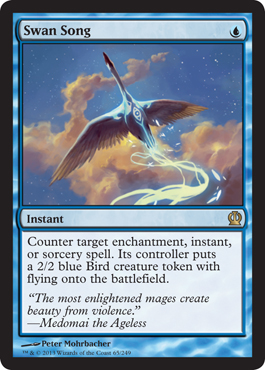
While I'm not the biggest fan of counter-control play styles, this is definitely an exception. For one mana, you can counter instants, sorceries, and enchantments. The biggest part of this, though, is the enchantment part. Theros introduces two new combinations of cards that haven't really been seen in magic, no including the Future Sight set - Enchantment Creatures and Enchantment Artifacts. The only real cost, giving an opponent a 2/2 flyer, isn't too big of an issue compared to any threats you may be wanting to get rid of with this card, and it reminds me greatly of Beast Within, a destroy anything spell with another token generating cost to it.
2. Rescue from the Underworld
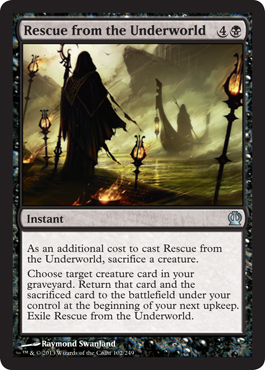
Reanimation has always been one of the easiest ways to cheat a creature card on to the battlefield. Standard has a couple of ways to bring creatures back from grave, and the most comparable are Unburial Rites and Ozbedat's Aid. All costing five mana, each has their advantage with rites being able to flash back from the grave itself for four mana and Ozbedat capable of grabbing any permanent instead of just a creature. Rescue from the Underworld, however has an extra cost, but that cost can be turned into a major advantage. By sacrificing a creature, you're able to grab a creature from your graveyard and return both creatures involved to the battle. This is gonna have a lot of interactions with creatures with enter the battle effects like my next choice.
3. Gray Merchant of Asphodel
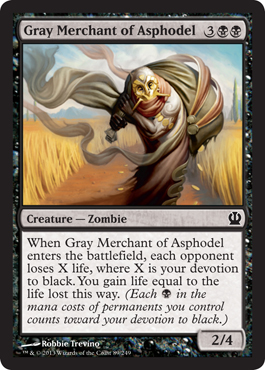
I'm not completely set on the devotion mechanic yet. But, this card might change my opinion. By itself, its just a 2/4 creature that steals two life from your opponent for five mana, which is sort of meh. When entering the battlefield of a black heavy deck, the story might be a little bit different. Then you go send your merchant friend down to the underworld to see what goods are available, and the game might be over even quicker. I do wish he was one mana less to allow an easier curve with Rescue from the Underworld, though.
4. Anger of the Gods
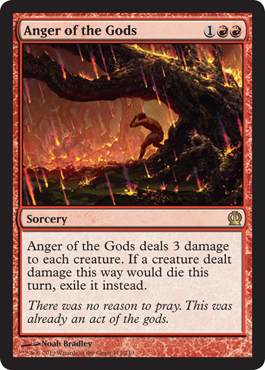
I'm just gonna go ahead and admit I hate this card. I'm a fan of small creature decks that want to beat down my opponent as quickly as possible. I know my creatures are gonna die, so I try to take advantage of that by bring them back as zombies when they die with Xathrid Necromancer. However, cards like this completely destroy that strategy. There is no dying and going to the graveyard. The just disappear, gone and exiled. And it can be played as early as turn three, completely incinerating any creatures that I may have played during my first two or three turns. GG.
5. Triad of Fates
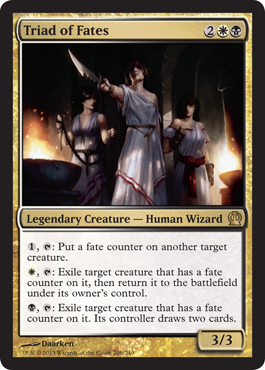
This card makes me excited for EDH, a format where you have a legendary creature head a deck of 100 different unique cards (outside lands) with the same colors. Triad of Fates has the ability to put a fate counter on another creature. It can then blink that creature in and out of the battlefield, reactivating enter the battlefield triggers, or it can turn exile that creature, either for card advantage for yourself or a costly removal for a threat. The only problem I see is that it does take two turns to complete this act, though there are cards that will let you get around this problem.
Thats it for now, and I'll be back tomorrow with more spoilers of Theros.
Wednesday, September 11, 2013
Introduction
Who am I? Just an individual starting a blog about the games they play. Whether it is review, record progress, brag, complain, or discuss, I will try to write it. Am I qualified? Hardly, but that doesn't matter too much.
Alright, with that out of the, I've got some goals that I'd like to complete during the duration of this blog.
-GGWP
Alright, with that out of the, I've got some goals that I'd like to complete during the duration of this blog.
- Get to gold ranking in League of Legends.
- Level all the characters in Diablo 3.
- Figure out how to play Final Fantasy XI.
- Finally download Final Fantasy XIV.
- Place in a Friday Night Magic tournament. (Something that isn't a video game, amazing, isn't it?)
-GGWP
Subscribe to:
Comments (Atom)